welcome to my blog !

This blog is written by trainers for trainers! We share our insights, knowledge and tips on training marine
mammals and all other critters. This blog is for YOU so feel free to use the comment section below to aid
in further discussion on related topics. Email me, [email protected] for comments,
suggestions or for permission to post your own blog.

November 16 2009

IMATA Career Building Workshop

Tagged Under : , , , , , ,

ABC Dolphin Trainer Academy had the honor to do a workshop at this year’s 37th International Marine Animal Trainers’ Association (IMATA) annual conference in Atlanta, GA. The workshop was called Career Building and we had three experienced instructors who provided tips and insights regarding career options, how to build resumes and how to do successful interviews. The response from those who participated in this workshop has been overwhelming. It was a true joy to meet many of you after the workshop and I continue to receive emails from those of you interested in pursuing a career in marine mammal training and I am humbled by your enthusiasm, passion and determination.

Together we will continue to improve the quality of the animal’s lives living under our care. You are the industries future and indeed I see a promising future for you and the animals you will care for. For those of you fortunate enough to attend the IMATA conference the theme was Teamwork and we all walked away I think with a true sense of what that means for us each and every day in our schools, jobs, and family.

Keep up the good work, and hopefully we will see you at next years IMATA conference in Boston for Career Building 2, the ABC Dolphin Trainer Academy is committed to you and we work hard every day towards our mission: to promote careers in marine mammal training and provide students with skills and knowledge to elevate their careers.

ABC Dolphin Trainer Academy at Dolphin Discovery, Isla Mujeres

ABC Dolphin Trainer Academy at Dolphin Discovery, Isla Mujeres

August 24 2009

Manatee Husbandry Training

Tagged Under : , , , , , , , , , , , , , ,

When Shelley asked me to write a blog, I was a bit hesitant because I have never “blogged” before….so bear with me if my comments aren’t presented in the typical fashion. For those of you that don’t know me, I was the Manatee Care and Training Coordinator at Mote Marine Laboratory & Aquarium for a decade (or so…) before working with Sea Life Park for a couple of years, and then was fortunate to land in my current Vice President of Conservation position with the Association of Zoos and Aquariums (AZA). As you can probably guess, two of my life passions include manatees and conservation…with that in mind…I thought I would focus my first blog on a topic that we as trainers usually first focus on with our animals – husbandry, or medical, training.

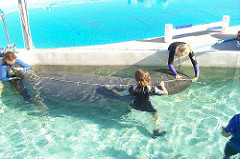
Voluntray lateral blood sampling

Voluntary lateral blood sampling

As you likely know, medical examination procedures with numerous species of non-domesticated animals in our care typically require some amount of physical or chemical restraint. An alternative to this is the implementation of an animal husbandry training program that uses standard operant conditioning with positive reinforcement techniques. The convenience of having animals voluntarily participate in routine medical procedures reduces their level of stress, increases health assessment opportunities, improves their level of care, furthers collection of baseline biological data, facilitates physiological research, and provides a dynamic form of environmental enrichment.
Medical procedures with untrained manatees require that the animal be dry-docked and restrained by numerous personnel. Husbandry training facilitates medical procedures typically carried out with restrained manatees, such as blood sampling, weight, dorsal ultrasound, body length, and girth measurements. Utilizing trained voluntary behaviors with manatees, allows these medical procedures to be conducted with increased frequency while reducing the number of handlers and amount of time needed per examination.
In addition, procedures difficult to obtain and rarely conducted with manatees when they are restrained, such as respirometry, ventral ultrasound, urine sampling, and core temperature measurements can become routine and incorporated into valuable physiological research investigations. Samples and measurements collected on a routine basis can be analyzed and the results can be used to augment our knowledge of the manatee’s physiology. Some of the studies conducted have provided important information about what factors affect manatee creatinine (stress) levels, how they thermoregulate, what hormonal fluctuations they cycle through, and how their respiratory characteristics contribute to red tide impacts. This information has direct conservation applications for both the in situ and ex situ manatee populations….and is made possible by basic husbandry training…how awesome is that!?

voluntary body length measurement

voluntary body length measurement

August 24 2009

Debborah Colbert’s Bio

Tagged Under : , , , , , , , , ,

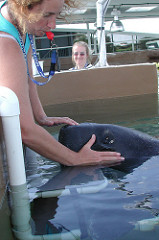
voluntary eye exam

voluntary eye exam

Debi was responsible for initiating the 1st USFWS permitted Manatee Training Program in the U.S. and was the Manatee Care and Training Coordinator at Mote Marine Laboratory and Aquarium for over nine years. She has an extensive background in conservation research training, with a particular focus on manatee sensory biology, behavior, animal training and husbandry, but also has cetacean stranding and sea turtle training and care experience.

She was also the Director of Research and Education at Sea Life Park in Hawaii, has served as Secretary on the International Marine Animal Trainers Association’s (IMATA) Board of Directors, and is currently their Research and Conservation Committee Chair.

Currently, she is the Vice President for Animal Conservation with the Association for Zoos and Aquariums (AZA) and is responsible for overseeing AZA’s core animal programs, facilitating the work of AZA’s members in cooperative population and collections management, and the advancement of AZA’s conservation and science initiatives.

She earned her Ph.D. in psychology (cognitive and neuroscience) from the University of South Florida.

June 11 2009

Are we tamers or… Trainers?

Tagged Under : , , , , , , , , , , , , , , , , , , , , , , , , , , , , , ,

We have shared the earth with animals since Homo sapiens walked the planet and in the beginning, like it or not, we viewed them solely as a source of food. As time passed, we saw them as tools to help make our tasks easier and then finally, we have domesticated them for companionship.
When we talk about marine mammals, and specifically Dolphins, we find a multitude of stories about these creatures, for instance;

As noted by Bearzi and Stanford (2008, pg. 18). “Intelligence, consciousness and compassion were among the words used by the ancient Greeks to describe their ‘companions of the sea’. The philosopher Plutarch regarded them as the only creatures that seek friendship for purely altruistic reasons. Greek myths portray that culture’s fascination with dolphins: the sun god Apollo assumed the form of a dolphin when he founded his oracle at Delphi on the slopes of Mount Parnassus, and Orion was saved from drowning by a sociable dolphin and carried into the sky, riding on his back.

Dionysus the Greek god of wine and mirth, who once booked passage on a ship from the island of Ikaria bound for Naxos. The ship’s crew was actually a band of pirates posing as merchant sailors, whose secret plan was to capture their passengers and sell them into slavery. When Dionysus discovererd their conspiracy, he used his divine powers to punish them by causing the ship’s mast to sprout branches, the men’s oars to become snakes and a strange flute to play. To escape this divine madness, the pirates cast themselves into the water where the ocean god Poseidon change them into dolphins and commanded them to serve humankind forever.

A century later, the Roman philosopher Pliny the Elder told the story of a peasant boy living on the shores of the Mediterranean Sea who befriended a solitary dolphin named Simo. Everyday Simo used to take the boy on his back across a stretch of water between the child’s home and his school. Tragically, the boy fell sick and died. Upon the boy’s death and for many days thereafter, Simo kept returning to the place of their meeting until he too died of a broken heart. Simo’s story is one of the countless legends of friendship between children and dolphins that were popular during the Roman Empire. As it was with the Greeks, the Romans were fascinated with these creatures.
Leaving mythology aside and getting back to business, I should make mention of Germany’s Carl Hagenbeck (1844–1913), who is considered the father of the modern zoo, and who in 1875, trained animals for display in circuses throughout Europe and the United States. At that time, training was done in whatever way they felt like doing it. Carl Hagenbeck always dreamed of a permanent exhibit where animals could live without bars and in surroundings much like their natural environments. His vision went on to become the basis of today’s zoological exhibits and was even considered the beginnings of the cinema experience!
Starting in 1943, B.F. Skinner pioneered a theory of behaviour modification utilising a technique called Shaping (hand-shaping), which is generally known as Operant Conditioning and is stated as: - Behaviour is a function of its consequences; consequences are what follow a behaviour.

And this has revolutionized animal training!

At Dolphin Discovery, the ABC Animal Training program is based on this technique and using it, we are able to achieve very impressive co-operative behaviours from our animals.
Some examples being;
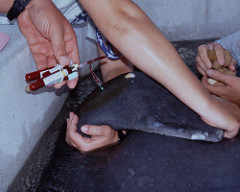
training manatees for voluntary blood samples,
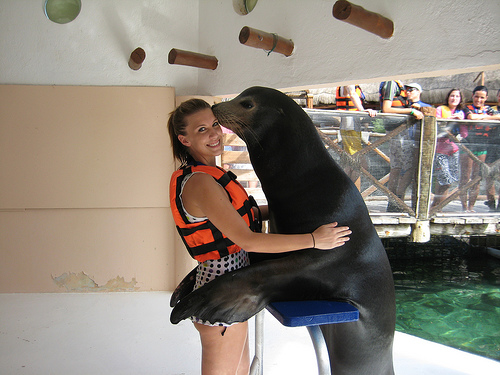
Jackie gets a hug at ABC Dolphin Trainer Academy

Jackie gets a hug at ABC Dolphin Trainer Academy

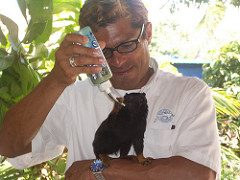
• facilitating Tamarin monkeys’ ability for recall,
• interactive programs and diving with sea lions
• the best interactive programs with dolphins.


People dream of petting dolphins and in enabling them to do this, we ensure that all of our interactions with the animals are based entirely on positive reinforcements.
Therefore:
Each interaction with the animals should be interesting and mentally stimulating, even fun.
• Desirable behaviours must be reinforced with primary and secondary reinforcements, not drawing attention to undesirable behaviours.
Relationships are built based on mutual trust and respect, not only must the trainer trust they will not be harmed by the animal, but the animal must also trust that the trainer will not harm them.

A few years ago, I was in charge of the Anguilla, B.W.I. facility; a beautiful and fantastic island in the western Caribbean.
The dolphin population consisted of four boys and three girls. (4.3 dolphins)
One of them was an awesome dolphin and the sweetest girl ever named Ayla. She was eight months pregnant and I was doing some cleaning in the lagoon. After I finished, I forgot my snorkel at the edge of the pool, and with waves washing over it, it sank all the way down to the bottom.
Once the snorkel was there, Ayla found it and took it underneath her right pectoral flipper, becoming the best treasure ever for her.
She would not give it away even for two pounds of herring!
We worked out a plan with all the little details involving doing successive approximations until she gave it away by herself. With this whole experience, we found the best secondary reinforcement to use with Ayla.
The plan was really simple:
#1 - Hand target with the snout/ then primary.
#2 - Hand target with the snout and presenting left hand by right pectoral fin/then primary.
#3 - Approximation # 2 plus having the hand closer to her flipper/ then primary
#4 - Approximation # 3 plus touching her flipper/then primary.
#5 - Approximation # 4 plus touching the snorkel/then primary.
#6 - Approximation # 5 plus holding the snorkel for a sec and giving it back to her/jackpot
#7 - Approximation # 6 plus holding the snorkel and moving two steps either way/jackpot and snorkel back to her
#8 - Approximation # 7 plus coming out of the water with the snorkel/jackpot and snorkel.

The schedules of reinforcement that we used was continuous with each step and the reinforcements were primary, starting the next session one step behind the last one.
As Karen Pryor (1994) states “Positive reinforcement training constitutes an exchange of deeds for goods in which a pleasant communion arises a salutary sort of equality between animal and trainer, one cannot work without the other and both must do their part. That is reinforcing in itself, for both parties.”
At this point, I must state that “tamers” are history and we at Dolphin Discovery, we are real trainers.

References
Bearzi, M. and Stanford, C.B. (2008) Beautiful Minds: The Parallel Lives of Great Apes and Dolphins, Cambridge, Harvard University Press.
Pryor, K. (1994) On Behaviour; Essays and Research, Waltham, Mass., Sunshine Books.
May 26 2009

Training in the Caribbean

Tagged Under : , , , , , , , , , , , , ,

Yah man!

Arriving on the British Virgin Islands for the very first time was one of the best experiences that I have ever had. Having four dolphins in my charge for basic training and making them feel comfortable in their new environment was a learning opportunity every single day. Even though I am experienced with dolphins, this represented a big challenge for me.

Raul training a golden hand tamarin monkey Dolphin Discovery

Raul training a golden hand tamarin monkey Dolphin Discovery

Training was just a small part of the experience that helped me to sharpen my skills and to become the person and trainer that I am today.
What really taught me how to be a trainer was, on a daily basis, living in a new place, in a different culture, with a huge diversity of races, plus having no guacamole! Even though I have lived in many places in the world, the Caribbean at that time, was a different experience for me; it was way too laid back. For instance, the exasperating attitude of; “Don’t worry, yah man, tomorrow will be ready”, when you really needed it yesterday!
My point being, if you don’t open yourself up to new opportunities and learn from them, you will never be able to find a way to get the best out of the circumstances that you encounter. No matter what, without exception, you can always find something worthwhile to learn.
You must believe in yourself and your dreams. It’s really easy to say but once you have it in the forefront of your thoughts, things do turn out differently, and believe me - it’s true!
What is your goal in life and what are your dreams? For sure you must first have an idea, then follow it, fight for it and do not let any obstacle steer you away from it, even to the point of quitting. Focus on your dream and make it happen.
We are always going to crash into something that we don’t like, that makes us feel uncomfortable or perhaps even something worse. Yeah, that’s for sure!
If you reach a stage where you feel you are breaking down, thinking “that is enough” or, that you do not deserve it, this is going to take you nowhere. You will not be thinking clearly and all the possibilities of success will fade away, therefore:
“I got stuck and I cannot do it”, will become part of your life.
Putting this attitude into a training scenario, these would be your thoughts while you are doing your job with the animals that you love the most. This wouldn’t be fair to them because there is always a little spark of opportunity in front of you and with an understanding of the scenario, you will get it.
This is what ABC is about; never to have the attitude of being closed to any option or having one of failure. That it teaches the best way to understand animals’ needs and how to see them, improving the animals’ life within any single session and even how to apply it to your fellow mates, remember that little spark is always in front of you.
Putting it this way - use the right criteria, according to the right scenario, through positive reinforcements. And then you will reach the next step!
In my case – my “Yah man” experience really helped me to grow as a person and being a part of ABC has made everything easier and taught me how to communicate in a better way with both animals and humans.

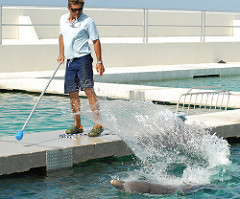
Raul training a tail splash Dolphin Discovery Cayman

Raul training a tail splash Dolphin Discovery Cayman

To grasp it was not easy but Dolphin Discovery is a great family that offers extensive support and listens to your concerns.
ABC is a part of Dolphin Discovery. I am proud to say that I am a member of Dolphin Discovery and I love every single moment of my experience, there are so many stories to tell and all of them have a smile in them…..
Jeez, I just got goosebumps!
Cheers heaps Mates! Raul

March 16 2009

Get a Real Job!

Tagged Under : , , , , , , ,

8 year old drawing after swim with dolphin at Dolphin Discovery

Understanding the Dream Stealers

‘Hey, Ms. trainer, when you gonna get a real job?’ Sound familiar? For many of my colleagues and myself we heard this all throughout our careers as animal trainers. Mostly we heard this from those closest to us, our family! Training Flipper was not seen as a profession, it was a summer job at best. They hoped that soon we would tire of playing with dolphin, whales and sea lions and come to the realization that hey, maybe we should shake off this animal thing and get a real job. At the ABC Dolphin Trainer Academy we call these people the dream stealers. We don’t talk about them in a negative way, no; after all we are usually talking about your mom, dad, aunt, uncle, and grandparents. Rather we focus on not changing their minds but rather we focus on you, the student and what you can do to make your dream a reality.

To be fair our families only wanted what was best for us and they simply couldn’t understand how training animals could be a respectable profession. And the money, I need to be honest; I don’t know one trainer who began their career for the financial rewards. Trainers usually begin their careers with passion. Passion for the animals, passion for the environment and passion to make a better world. I call this the honeymoon stage. Why? Because animal training is a real job! It’s not all fun and games. It can be difficult, strenuous work. Trainers work long hours, work outside in all weather, spend much of the day wet and every aspect of the job is heavy. Atlantic bottlenose dolphin eat anywhere from 10 to 40 lbs of fish a day- multiply that by how many animals at the facility and that’s a lot of fish to move around. An average dolphin weighs between 300 to 500 lbs., add on the weight of transport equipment and your talking upwards to 700 lbs. to be carried.

Mario and Pepe training session in Dolphin Discovery Puerto Vallarta

There are lots of rewards however, and it is precisely that passion that motivates us. It really is a powerful experience knowing you are responsible for making positive influences in the quality of the animals’ lives. It’s a special accomplishment to be an integral part of the animal/trainer learning process. And how about the feeling you get when you touch someone else’s life for the positive? It can be something as simple and wondrous as a smile on a child’s face or knowing that you are an important part educating the public about conservation awareness and environmental issues.

So dream on friend, go for what you want, just make sure you go at in an intelligent thoughtful manner. Don’t let the dream stealers take anything away from you.

Happy Training!

Shelley

February 06 2009

From Dolphin Trainer to Teacher

Tagged Under : , , , , , , , , , , , ,

Me as a Trainer

I’ve been training dolphins and other critters for some 18 years now and a few years back I was asked to stop working dolphin everyday and create an education course for our trainers at Dolphin Discovery. I must admit, my first answer was a polite ”no thanks”. Well turns out like most requests from your employers it wasn’t really a request. It was an order. I was totally bummed and wondered why I was being punished. If memory serves me correctly I even shed more than a few tears.

So I found myself I trading my wet suit for normal working clothes and, most horrific of all SHOES! I discovered the hard way that corporate type folks frown upon bare feet in the office. And as a side note I also discovered that daily trainer activities such as talking to yourself, singing, and yes, even dancing are also unacceptable office conduct. Go figure. It should be no surprise then that my tiny office eventually was located as far away from all the other office people as possible. That was all right by me.

Well, time past and I flung myself wholeheartedly into my new project, acquiring skills I never knew I needed, much less wanted. I learned movie editing software, camera angles, lighting and other such things needed for a successful DVD production. ABC of Animal Training was born. I also learned power point and refined public speaking skills and such for classroom seminars. Dolphin Discovery now has a state of the art in-house training program for its trainers. To my surprise I just recently began teaching these classes to the public,ABC Dolphin Trainer Academy, which is a 5-day hands on workshop with marine mammals.

Being a trainer is an evolutionary process. When your first start learning your humble and wide eyed and think only of yourself and how someday you too want to be that trainer, yeah, her, the one in the water, whistle in her mouth swimming with HER dolphin. Then you learn a few things, become cocky and all sure of yourself and think you were put on this earth by God almighty to train animals. If you stay in the business long enough that phase mercifully dies a miserable, painful death. You begin, slowly at first mind you, to actually listen to the dolphin, actually really see them for the first time. Once you acquire these new skills the dolphin teach you more than you ever thought possible. Humility returns and you realize after all it really isn’t about you, the trainer, it’s about the animals, the reason you became a trainer in the first place.

My class

The most common question I get from trainers is “Shelley, don’t you miss the dolphins? This is the funny part. NO, I don’t. Let me try to explain.
So do I miss the dolphin? No, I don’t. My teaching allows me the ability to reach out and affect animal’s lives so they may live a happy, healthy life living under human care. Before I could only affect the animals directly under my supervision. But now, I’m blessed to have the opportunity to affect dolphin and other animals all over the world. This is what motivates me. To see a trainer ‘get it’ knowing full well the animal reaps all the benefit. So that’s my mission, that’s my goal, create happy trainers and happy dolphins. That’s what I call Happy Training!

Shelley

February 02 2009

Shelley Wood Bio

Tagged Under : , , , , , , , , , ,

Shelley has been training dolphin, sea lions, and other animals since 1990. In 1994 she moved to Cancun Mexico where she played an intricate role in the development and opening of Dolphin Discovery. Her career with Dolphin Discovery has seen Shelley evolve from hands on animal trainer to her current position as Corporate Trainer Educator (CTE) for all Dolphin Discovery facilities. As CTE she is responsible for the development of curricula, courses, and guidelines used in Dolphin Discovery’s continuing trainer education program.

Shelley is also owner of ABC Training Systems a company dedicated to producing educational material about the humane training of animals. She is the author of ABC of Animal Training.