welcome to my blog !

This blog is written by trainers for trainers! We share our insights, knowledge and tips on training marine
mammals and all other critters. This blog is for YOU so feel free to use the comment section below to aid
in further discussion on related topics. Email me, [email protected] for comments,
suggestions or for permission to post your own blog.

January 06 2010

Spinner Dolphins, Big Fish and Christmas

Tagged Under : , , , , , , , , , , , , , , , , , , , ,

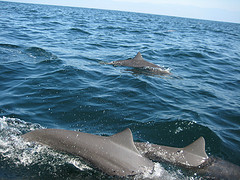
spinner dolphins follow our  boat

Spinner dolphins follow our boat

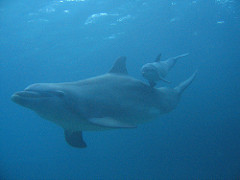
The day after Christmas as the early morning sun was peaking over the Sierra Madre mountains we were some 7 miles off shore from a little surfing town called Puerto Escondido, Mexico. Paco, Paula, Mike and myself rented a fishing boat with grand notions of landing the big fish, Tuna, Sailfish, Mahi Mahi and Marlin. In our search for the big fish we kept a look out for dolphin and birds, hoping they would lead us to some good fishing. About an hour or so into the trip we saw some water splashing off in the distance and steered the boat straight for it. As we approached we saw that the splashing was from dolphins, actually several hundred dolphins. We were completely surrounded by several hundred Spinner dolphin (Stenella longirostris). To say this experience was spectacular is an understatement. Now I’m no John Irving and can’t paint pictures with words but this was a ‘wow , I can’t believe this is happening’ experience. When I say surrounded there was no gap in the water without dolphin. They were so close to the boat that the spray from their blowhole could easily mist your face and you could see dolphin jumping and spinning as far as the eye could see.

SPINNER DOLPHINS YOUTUBE VIDEO

At first it was difficult to take it all in, to understand what we were seeing as there was so much dolphin action. Your eyes kept jumping from one jump to the next. There were dolphin jumping, spinning, flipping, tail splashing, bow riding, boat following. The aerials took your breath away. Spinner dolphins certainly are the definition of beauty and grace. The spins frequently had at least 3 1/2 turns with an occasional back flip thrown in for good measure. They were made up of all sorts of configurations that as a tursiops dolphin trainer I honestly never thought a dolphin could do. In fact I’m sure that if our Atlantic bottlenose dolphins (Tursiops truncatus) could have witnessed the spinners they would have been just as amazed at their speed, agility and perpetual motion as I was.

And the babies! There were calves everywhere. The calves were just as active as the adults, baby jumping, spinning and flipping. Once your eyes began to adjust to so much movement you could hear them too, squeaks and whistles. The action never stopped, dolphins spinning and jumping seemingly forever. Why do spinners spin and jump and in general carry on? I don’t know, some people say for communication, to dislodge parasites, but to us, it looked like they did it for shear pleasure.
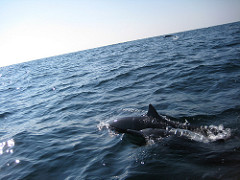
Spinner dolphins follow and spin

Spinner dolphins follow and spin

Spinner dolphins are a smaller dolphin with long slender rostrums and this pod was completely gray in color, both dorsal and ventral. Our guide told us that the males had a kind of backward dorsal fin where the curve is forward, toward the head. I had never heard of this before but it was very true, we saw dolphin with this unfamiliar dorsal fin shape. We also saw several dolphins with dorsal fins that were folded over and some that looked like the dorsal was completely cut off. Also very striking was that we saw not a rake mark in the bunch.
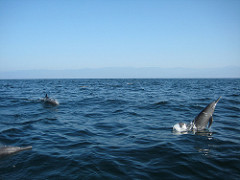
Spinner dolphins following and spinning

Spinner dolphins spinning and jumping

After an hour or so of taking a gazillion photos and video the boat Capitan persuaded us we had to head back toward shore. None of us wanted to leave. On the way back we saw Pacific green sea turtles (Chelonia mydas) mating, spotted eagle rays (Myliobatis sp.) jumping and spotted dolphin (Stenella attenuata) that were so shy they would ride the bow of the boat for only a few seconds and then vanish as quickly as they appeared.

I’m thankful to Paco and Paula for not only sharing the experience with us but also for sharing their great video. I’m extremely grateful that all of us walked away that afternoon with a huge appreciation of what we had just experienced. I’m also very thankful to my husband Mike for inspiring us to book the fishing trip. Which reminds me, what happened to the fish? I had never seen a bunch of people so happy after not catching any fish. Guess we forgot all about them once we shared our lives for a brief moment with surely one of the coolest species on the planet. .
June 30 2009

The Best Trainer in the World

Tagged Under : , , , , , , , , , , , , , , , , ,

Who is the best trainer in the world?

You only have to look in the mirror to find the best trainer

You only have to look in the mirror to find the best trainer

When somebody asks this question, for sure a couple of names will pop into your head: maybe the people that have published a couple of books; your boss; a co-worker or even a friend of yours.
OK!
Those are all possibilities and of course make sense, but did you ever think that it could be you?
Yep!
Maybe you do not have that many years of experience behind you or the other way around, you have lots of experience but nobody knows your name. Sometimes, to be the best, it isn’t necessary to have either of these aspects because to do our work properly we need passion, therefore:
The best trainer in the world is the one that has fun doing what they love.
We need to grasp the meaning of this because if we just read it, we might think of “having a party with the animals” or “partying like an animal”, which is worse, and believe me, that’s not what it is about!
To make it clear I should start from the basics:
Humility
To succeed in any field, being humble creates an opportunity for understanding. By not just reacting to uncomfortable situations or lack of progress, it enables you to listen and be open to different options, gaining new perspectives from others. It gives you the opportunity to improve yourself, enhancing communications with your co-workers and therefore being able to maintain the highest standards for the animals under your care.
Ego is not a tool that is useful to our work, but a Smile, definitely - YES!
Being humble is a premier quality in interacting with co-workers and it is a core competency in working with animals.
Do these phrases sound familiar:
“My dolphin is too lazy today!”
“My sea lion is not paying attention at all!”
“My dolphin did not want to come out from the holding pen!”

It is at this point that we need to be humble. To admit that, actually, it is not the animals that are failing, it is we the trainers who are failing the animals because we are no longer providing them with the right communications, stimuli or even the tools to motivate them so that they can reach the proper criteria.
We might even say:
“There are no difficult animals only stubborn trainers!”
Each animal has their own likes, dislikes and has different moods as well. There is no difference between a young calf and an animal with years of experience in training. We need to understand the scenario and read the body language at that given moment, to understand what is going on.
Not having a clue as to what would happen and pushing an animal to do certain behaviours or reach a criteria can become frustrating and therefore, removes any element of fun, with the result that your animal will fail as many times as you ask for the Sd or whatever you are working on.
• Observe the scenario, including peripherals.
Read the body language, what is the animal showing you,
• Work with a variety of reinforcement schedules and use different stimuli to lead the session to success.

Mom and calf Dolphin Discovery Cozumel

Mom and calf Dolphin Discovery Cozumel

For instance:
I was working in Dolphin Discovery, Riviera Maya, Mexico and I had under my charge a female dolphin named Venus (12 years old) and she just had a baby, Audry (3 months old). At that time she was in a holding pen big enough to hold another female, Athena (15 years old), and her calf, Frida (3 months old).
Venus, who had many years of training at that time, was really fun and even easy; she could learn a new behaviour in a really short period of time. I must say at this point that she had fantastic trainers before me who had worked with her in a really positive way all the time, therefore TRUST was a main component of the relationship with her.
The facility was undergoing a few changes and a new holding pen was being built specifically as a maternity pen. Once the maternity pen was completed we needed to move all four animals into their new home.
A plan was made and everything went really smoothly, each mother did their work in bringing their calves through the gates with them. Edgar Urbina was in charge of this operation and during the whole process everything was perfect; fast, clean and smooth!
Once we had the dolphins in their new home we were ready to do the first session on the submerged platform. Venus was already aware of this stimulus and would not be a problem at all, that’s what I thought!
Starting with myself on the platform, asking for station, Venus was cruising twenty feet away from me and only occasionally peeking at me.
Having this scenario, I had decided to bring a target pole to motivate her to come and also did a couple of hand slaps on the surface of the water. No response from her, not even one foot closer and, of course, having my boss standing behind me, this was not exactly what I was expecting!
Throwing fish to her or swimming out of the platform was not the proper plan to follow, Venus was experienced and doing that would be taking too many steps backwards - that was my thought-
Having this on my mind, I clearly remember Edgar’s voice telling me:
- Remember, you should do all sessions positively. Look at the scenario, which is new, and use a continuous schedule of reinforcements, with good and nice approximations, and you will have success. Swim out for her!


And YES! It worked as if by magic!
I swam out, hand target right in front of her, a continuous schedule of reinforcements, swimming all the way back to the platform, and she came with me, no problem at all. As soon as we reached the platform, I gave her a jackpot and we finished the session on a positive note.
The next session in the new area with her was very smooth and easy, like she’d always done it.
Factors that may have caused this avoidance behaviour by Venus in the new area:
• New area, protecting the calf.
• Stress from the session before, gating.
Solution:
Work on trust with Venus by swimming towards her and using a continuous schedule of reinforcements, with small approximations, making the new area positive and safe for her, and therefore for her calf.
With Venus, in this particular case, Venus responded quickly due to her background training and her personality, but with another animal it might take a little longer but just as effective!
My point being that the best trainer in the world lives inside every trainer; it’s just a matter of understanding the path that you need to follow, according to the animal that you are working with. Maybe these points might give you a better understanding:
• Learn to read your animal’s body language.
• Beware of any changes in the scenario and make it work.
• Always work on positive approximations.
• Do not push, do understand the scenario instead.
• If something goes wrong, be cool and do not draw attention to it.
And most important of all: be humble at all times in order to see what you are doing wrong and next time, do it easy and make it clear for the animal, in a positive way, in order for them to succeed.
ABC of Animal Training will guide you to find the best trainer in the world inside yourself for sure.
And I would like to steal the phrase,
Happy Training!
That word means a lot if you really think about it.

Cheers Mates.

Happy Training!

Happy Training!

May 27 2009

Raul Novelo’s Bio

Tagged Under : , , , , , , , , , , ,

Raul Novelo will never forget the first time that he saw a dolphin show, it was 1977 and he was eight years old when he visited the Miami Seaquarium. According to his mother, he stayed by the dolphin pool forever and might still be there if she hadn’t dragged him away!
In 1991 Raul graduated with a degree in Business Administration. In 1995 Raul was first hired at Via Delphi in X’caret Park and then went on to do an internship at Dolphin Quest, Bermuda.
Raul first found his career after he met Shelley and Mike Wood of Dolphin Discovery and ABC Animal Training during the regional IMATA conference in Mexico.
In 2002 Raul began his career with Dolphin Discovery Mexico and has extensive experience in British Virgin Islands working as Senior Trainer at both Dolphin Discovery location in Antigua and Anguilla and as Supervisor at both Dolphin Discovery locations in Tortola and Cayman.

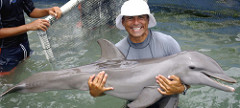
Raul with dolphn calf at Dolphin Discovery Tortola

Raul with dolphn calf at Dolphin Discovery Tortola

May 26 2009

Training in the Caribbean

Tagged Under : , , , , , , , , , , , , ,

Yah man!

Arriving on the British Virgin Islands for the very first time was one of the best experiences that I have ever had. Having four dolphins in my charge for basic training and making them feel comfortable in their new environment was a learning opportunity every single day. Even though I am experienced with dolphins, this represented a big challenge for me.

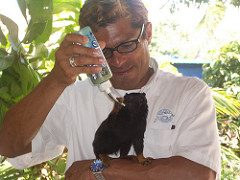
Raul training a golden hand tamarin monkey Dolphin Discovery

Raul training a golden hand tamarin monkey Dolphin Discovery

Training was just a small part of the experience that helped me to sharpen my skills and to become the person and trainer that I am today.
What really taught me how to be a trainer was, on a daily basis, living in a new place, in a different culture, with a huge diversity of races, plus having no guacamole! Even though I have lived in many places in the world, the Caribbean at that time, was a different experience for me; it was way too laid back. For instance, the exasperating attitude of; “Don’t worry, yah man, tomorrow will be ready”, when you really needed it yesterday!
My point being, if you don’t open yourself up to new opportunities and learn from them, you will never be able to find a way to get the best out of the circumstances that you encounter. No matter what, without exception, you can always find something worthwhile to learn.
You must believe in yourself and your dreams. It’s really easy to say but once you have it in the forefront of your thoughts, things do turn out differently, and believe me - it’s true!
What is your goal in life and what are your dreams? For sure you must first have an idea, then follow it, fight for it and do not let any obstacle steer you away from it, even to the point of quitting. Focus on your dream and make it happen.
We are always going to crash into something that we don’t like, that makes us feel uncomfortable or perhaps even something worse. Yeah, that’s for sure!
If you reach a stage where you feel you are breaking down, thinking “that is enough” or, that you do not deserve it, this is going to take you nowhere. You will not be thinking clearly and all the possibilities of success will fade away, therefore:
“I got stuck and I cannot do it”, will become part of your life.
Putting this attitude into a training scenario, these would be your thoughts while you are doing your job with the animals that you love the most. This wouldn’t be fair to them because there is always a little spark of opportunity in front of you and with an understanding of the scenario, you will get it.
This is what ABC is about; never to have the attitude of being closed to any option or having one of failure. That it teaches the best way to understand animals’ needs and how to see them, improving the animals’ life within any single session and even how to apply it to your fellow mates, remember that little spark is always in front of you.
Putting it this way - use the right criteria, according to the right scenario, through positive reinforcements. And then you will reach the next step!
In my case – my “Yah man” experience really helped me to grow as a person and being a part of ABC has made everything easier and taught me how to communicate in a better way with both animals and humans.

Raul training a tail splash Dolphin Discovery Cayman

Raul training a tail splash Dolphin Discovery Cayman

To grasp it was not easy but Dolphin Discovery is a great family that offers extensive support and listens to your concerns.
ABC is a part of Dolphin Discovery. I am proud to say that I am a member of Dolphin Discovery and I love every single moment of my experience, there are so many stories to tell and all of them have a smile in them…..
Jeez, I just got goosebumps!
Cheers heaps Mates! Raul

May 20 2009

Continuing Education Units Now Offered!!!

Tagged Under : , , , , , , , , , , , , ,

2009 Feb ABC Dolphin Trainer Academy students practice with sds, reinforcements, bridge with dolphin Alexia and her 3 month calf.
ABC Dolphin Trainer Academy students practice training skills with Alexia and her 3 month calf.

ABC Dolphin Trainer Academy has great news. In accordance with our commitment to assisting students with their professional development and growth in the successful pursuit of an animal training career we are proud to announce that students may earn Continuing Education Units (CEU). University of Wisconsin Stevens Point (UWSP) has approved the ABC Dolphin Trainer Academy for 2. 72 CEU’s to be earned for the Basic workshop. Upon successful completion of the workshop students will receive a transcript from UWSP. The CEU’s are transferable to most other universities and some universities may accept the CEU’s as college credits. CEU’s are a valuable resource on your resume.

To receive the official transcript students simply need to contact:

Julie M. Hellweg, Program Manager
UWSP Continuing Education
Phone: 715-346-3730 Fax: 715-346-3504
email: [email protected]

March 16 2009

Get a Real Job!

Tagged Under : , , , , , , ,

8 year old drawing after swim with dolphin at Dolphin Discovery

Understanding the Dream Stealers

‘Hey, Ms. trainer, when you gonna get a real job?’ Sound familiar? For many of my colleagues and myself we heard this all throughout our careers as animal trainers. Mostly we heard this from those closest to us, our family! Training Flipper was not seen as a profession, it was a summer job at best. They hoped that soon we would tire of playing with dolphin, whales and sea lions and come to the realization that hey, maybe we should shake off this animal thing and get a real job. At the ABC Dolphin Trainer Academy we call these people the dream stealers. We don’t talk about them in a negative way, no; after all we are usually talking about your mom, dad, aunt, uncle, and grandparents. Rather we focus on not changing their minds but rather we focus on you, the student and what you can do to make your dream a reality.

To be fair our families only wanted what was best for us and they simply couldn’t understand how training animals could be a respectable profession. And the money, I need to be honest; I don’t know one trainer who began their career for the financial rewards. Trainers usually begin their careers with passion. Passion for the animals, passion for the environment and passion to make a better world. I call this the honeymoon stage. Why? Because animal training is a real job! It’s not all fun and games. It can be difficult, strenuous work. Trainers work long hours, work outside in all weather, spend much of the day wet and every aspect of the job is heavy. Atlantic bottlenose dolphin eat anywhere from 10 to 40 lbs of fish a day- multiply that by how many animals at the facility and that’s a lot of fish to move around. An average dolphin weighs between 300 to 500 lbs., add on the weight of transport equipment and your talking upwards to 700 lbs. to be carried.

Mario and Pepe training session in Dolphin Discovery Puerto Vallarta

There are lots of rewards however, and it is precisely that passion that motivates us. It really is a powerful experience knowing you are responsible for making positive influences in the quality of the animals’ lives. It’s a special accomplishment to be an integral part of the animal/trainer learning process. And how about the feeling you get when you touch someone else’s life for the positive? It can be something as simple and wondrous as a smile on a child’s face or knowing that you are an important part educating the public about conservation awareness and environmental issues.

So dream on friend, go for what you want, just make sure you go at in an intelligent thoughtful manner. Don’t let the dream stealers take anything away from you.

Happy Training!

Shelley

February 02 2009

Shelley Wood Bio

Tagged Under : , , , , , , , , , ,

Shelley has been training dolphin, sea lions, and other animals since 1990. In 1994 she moved to Cancun Mexico where she played an intricate role in the development and opening of Dolphin Discovery. Her career with Dolphin Discovery has seen Shelley evolve from hands on animal trainer to her current position as Corporate Trainer Educator (CTE) for all Dolphin Discovery facilities. As CTE she is responsible for the development of curricula, courses, and guidelines used in Dolphin Discovery’s continuing trainer education program.

Shelley is also owner of ABC Training Systems a company dedicated to producing educational material about the humane training of animals. She is the author of ABC of Animal Training.