welcome to my blog !

This blog is written by trainers for trainers! We share our insights, knowledge and tips on training marine
mammals and all other critters. This blog is for YOU so feel free to use the comment section below to aid
in further discussion on related topics. Email me, [email protected] for comments,
suggestions or for permission to post your own blog.

September 10 2009

From pinnipeds to tigers, a zoo perspective

Tagged Under : , , , , , , , , , , , , , , , , , , , , , , ,

Since I was young, I have always dreamed of becoming a marine mammal trainer and in 1988 began by volunteering at a pinniped facility in Milwaukee, WI, which provided shows and interactive programs to the zoo going public. I was fortunate to be hired and began training seals and sea lions just two years later in 1990 and soon became the Senior Trainer. Because the sea lion facility was based in a zoo, the opportunity arose to consult in other areas of the zoo that had training needs and I was able to teach keepers to train a variety of other zoo species operant conditioning techniques to allow simple shifting to complex behaviors in order to cooperate in their own medical care. I quickly became passionate with the ability to teach keepers how to provide the best possible care for their animals which includes shifting animals on/off exhibit or from one enclosure to another as well as to perform medical behaviors from body part presents to advanced behaviors such as blood draws and hand injections.
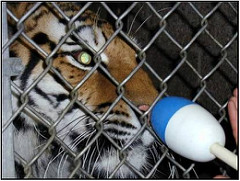
Protected Contact Training

Protected Contact Training

This was a challenge initially as the training with bonobos, gorillas, orangutans, giraffes and elephant is protected contact and is very different from training a sea lion where they are able to physically interact with you. Protected contact was new to me and it means there was a barrier between you and the animals. It is very exciting to see how the same training techniques can be applied to so many different species and how the training at times needs to be modified depending on the species and of course the institutions’ goals. After 10 years in Milwaukee working with an extremely diverse group of animals and trainers/keepers, I decided it was time to venture out on my own and I started my own training consultation company.
I started my first contract with Como Zoo in St. Paul, MN with the primary purpose of developing their seal/sea lion training and educational programs. Just as in Milwaukee, once the keepers from different departments noticed the positive changes that were made with the pinniped collection they wanted to start training their animals. Soon a zoo wide program was initiated and ultimately developed over several years to include the great apes (orangutans & gorillas), hoof stock (zebra, giraffe, kudu), big cats (cougars, snow leopards, tigers, lions) as well as sloths, porcupines, foxes, wolves, snakes, polar bears and tortoises. I have found the key for a successful program is to develop a trusting relationship with all the keepers I work with. The keepers know their animals best and since I only make site visits, it is imperative the keepers relay they correct information back to me. I then began working with Blank Park Zoo in Des Moines, IA to develop their seal/sea lion educational program as well as a big cat training program.
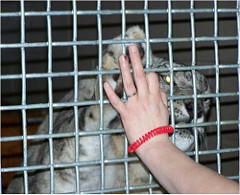
Target training snow leopard

Paw present snow leopard

After several years of training, the lions perform in educational demonstrations for the public to not only show how we can perform voluntary husbandry behaviors but also to highlight their natural behaviors to show a conservation message. The zoo noted the many benefits that the training provided and the program expanded to the whole zoo collection to include gibbons, otters, hoof stock, red pandas and a red tail hawk. I have also had the great opportunity to provide training seminars and training program evaluations for various zoos throughout the mid west.

I never thought when I was young that I truly would be training all these species of animals…dreams can come true if you work hard and are open to what comes across your path in life. This part of my life I did not expect and I am so grateful to be able to get involved and that is conservation work. My partner Dr. Mike Briggs and I started our own not-for-profit organization to perform carnivore research in Africa. I received a veterinary technician’s certification and license in 2004 and we began field work in Africa where Mike had been doing this work for years. Our organization, the African Predator Conservation Research Organization (APCRO) www.apcro.org, goal is to preserve the various carnivores found on the continent of Africa (lions, hyena, wild dogs, leopards, cheetah and jackals). We are a veterinary based organization looking primarily at disease transmission in novel species, emergence of new disease and the genetic and nutritional factors that may be influencing this problem. Doing conservation work to help preserve carnivores along with working with zoos to provide the best care for the animals allows for very complete feeling of self fulfillment, gratefulness, and humbleness to have the pleasure of fulfilling your personal and spiritual goals while spending your life struggling along with others who have the same passion for the best life of both captive and wild animals.
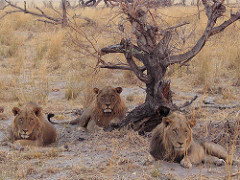
 African Predator Conservation Research Organization (APCRO) www.apcro.org
African Predator Conservation Research Organization (APCRO) www.apcro.org
August 24 2009

Manatee Husbandry Training

Tagged Under : , , , , , , , , , , , , , ,

When Shelley asked me to write a blog, I was a bit hesitant because I have never “blogged” before….so bear with me if my comments aren’t presented in the typical fashion. For those of you that don’t know me, I was the Manatee Care and Training Coordinator at Mote Marine Laboratory & Aquarium for a decade (or so…) before working with Sea Life Park for a couple of years, and then was fortunate to land in my current Vice President of Conservation position with the Association of Zoos and Aquariums (AZA). As you can probably guess, two of my life passions include manatees and conservation…with that in mind…I thought I would focus my first blog on a topic that we as trainers usually first focus on with our animals – husbandry, or medical, training.

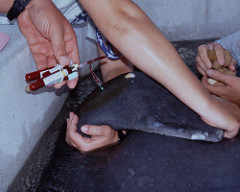
Voluntray lateral blood sampling

Voluntary lateral blood sampling

As you likely know, medical examination procedures with numerous species of non-domesticated animals in our care typically require some amount of physical or chemical restraint. An alternative to this is the implementation of an animal husbandry training program that uses standard operant conditioning with positive reinforcement techniques. The convenience of having animals voluntarily participate in routine medical procedures reduces their level of stress, increases health assessment opportunities, improves their level of care, furthers collection of baseline biological data, facilitates physiological research, and provides a dynamic form of environmental enrichment.
Medical procedures with untrained manatees require that the animal be dry-docked and restrained by numerous personnel. Husbandry training facilitates medical procedures typically carried out with restrained manatees, such as blood sampling, weight, dorsal ultrasound, body length, and girth measurements. Utilizing trained voluntary behaviors with manatees, allows these medical procedures to be conducted with increased frequency while reducing the number of handlers and amount of time needed per examination.
In addition, procedures difficult to obtain and rarely conducted with manatees when they are restrained, such as respirometry, ventral ultrasound, urine sampling, and core temperature measurements can become routine and incorporated into valuable physiological research investigations. Samples and measurements collected on a routine basis can be analyzed and the results can be used to augment our knowledge of the manatee’s physiology. Some of the studies conducted have provided important information about what factors affect manatee creatinine (stress) levels, how they thermoregulate, what hormonal fluctuations they cycle through, and how their respiratory characteristics contribute to red tide impacts. This information has direct conservation applications for both the in situ and ex situ manatee populations….and is made possible by basic husbandry training…how awesome is that!?

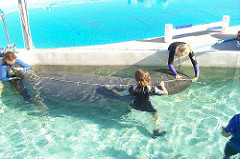
voluntary body length measurement

voluntary body length measurement

May 26 2009

Training in the Caribbean

Tagged Under : , , , , , , , , , , , , ,

Yah man!

Arriving on the British Virgin Islands for the very first time was one of the best experiences that I have ever had. Having four dolphins in my charge for basic training and making them feel comfortable in their new environment was a learning opportunity every single day. Even though I am experienced with dolphins, this represented a big challenge for me.

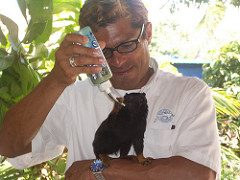
Raul training a golden hand tamarin monkey Dolphin Discovery

Raul training a golden hand tamarin monkey Dolphin Discovery

Training was just a small part of the experience that helped me to sharpen my skills and to become the person and trainer that I am today.
What really taught me how to be a trainer was, on a daily basis, living in a new place, in a different culture, with a huge diversity of races, plus having no guacamole! Even though I have lived in many places in the world, the Caribbean at that time, was a different experience for me; it was way too laid back. For instance, the exasperating attitude of; “Don’t worry, yah man, tomorrow will be ready”, when you really needed it yesterday!
My point being, if you don’t open yourself up to new opportunities and learn from them, you will never be able to find a way to get the best out of the circumstances that you encounter. No matter what, without exception, you can always find something worthwhile to learn.
You must believe in yourself and your dreams. It’s really easy to say but once you have it in the forefront of your thoughts, things do turn out differently, and believe me - it’s true!
What is your goal in life and what are your dreams? For sure you must first have an idea, then follow it, fight for it and do not let any obstacle steer you away from it, even to the point of quitting. Focus on your dream and make it happen.
We are always going to crash into something that we don’t like, that makes us feel uncomfortable or perhaps even something worse. Yeah, that’s for sure!
If you reach a stage where you feel you are breaking down, thinking “that is enough” or, that you do not deserve it, this is going to take you nowhere. You will not be thinking clearly and all the possibilities of success will fade away, therefore:
“I got stuck and I cannot do it”, will become part of your life.
Putting this attitude into a training scenario, these would be your thoughts while you are doing your job with the animals that you love the most. This wouldn’t be fair to them because there is always a little spark of opportunity in front of you and with an understanding of the scenario, you will get it.
This is what ABC is about; never to have the attitude of being closed to any option or having one of failure. That it teaches the best way to understand animals’ needs and how to see them, improving the animals’ life within any single session and even how to apply it to your fellow mates, remember that little spark is always in front of you.
Putting it this way - use the right criteria, according to the right scenario, through positive reinforcements. And then you will reach the next step!
In my case – my “Yah man” experience really helped me to grow as a person and being a part of ABC has made everything easier and taught me how to communicate in a better way with both animals and humans.

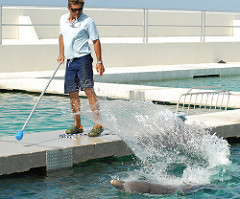
Raul training a tail splash Dolphin Discovery Cayman

Raul training a tail splash Dolphin Discovery Cayman

To grasp it was not easy but Dolphin Discovery is a great family that offers extensive support and listens to your concerns.
ABC is a part of Dolphin Discovery. I am proud to say that I am a member of Dolphin Discovery and I love every single moment of my experience, there are so many stories to tell and all of them have a smile in them…..
Jeez, I just got goosebumps!
Cheers heaps Mates! Raul

May 20 2009

Continuing Education Units Now Offered!!!

Tagged Under : , , , , , , , , , , , , ,

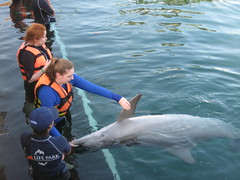
2009 Feb ABC Dolphin Trainer Academy students practice with sds, reinforcements, bridge with dolphin Alexia and her 3 month calf.
ABC Dolphin Trainer Academy students practice training skills with Alexia and her 3 month calf.

ABC Dolphin Trainer Academy has great news. In accordance with our commitment to assisting students with their professional development and growth in the successful pursuit of an animal training career we are proud to announce that students may earn Continuing Education Units (CEU). University of Wisconsin Stevens Point (UWSP) has approved the ABC Dolphin Trainer Academy for 2. 72 CEU’s to be earned for the Basic workshop. Upon successful completion of the workshop students will receive a transcript from UWSP. The CEU’s are transferable to most other universities and some universities may accept the CEU’s as college credits. CEU’s are a valuable resource on your resume.

To receive the official transcript students simply need to contact:

Julie M. Hellweg, Program Manager
UWSP Continuing Education
Phone: 715-346-3730 Fax: 715-346-3504
email: [email protected]