welcome to my blog !

This blog is written by trainers for trainers! We share our insights, knowledge and tips on training marine
mammals and all other critters. This blog is for YOU so feel free to use the comment section below to aid
in further discussion on related topics. Email me, [email protected] for comments,
suggestions or for permission to post your own blog.

January 06 2010

Spinner Dolphins, Big Fish and Christmas

Tagged Under : , , , , , , , , , , , , , , , , , , , ,

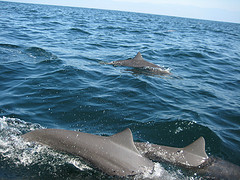
spinner dolphins follow our  boat

Spinner dolphins follow our boat

The day after Christmas as the early morning sun was peaking over the Sierra Madre mountains we were some 7 miles off shore from a little surfing town called Puerto Escondido, Mexico. Paco, Paula, Mike and myself rented a fishing boat with grand notions of landing the big fish, Tuna, Sailfish, Mahi Mahi and Marlin. In our search for the big fish we kept a look out for dolphin and birds, hoping they would lead us to some good fishing. About an hour or so into the trip we saw some water splashing off in the distance and steered the boat straight for it. As we approached we saw that the splashing was from dolphins, actually several hundred dolphins. We were completely surrounded by several hundred Spinner dolphin (Stenella longirostris). To say this experience was spectacular is an understatement. Now I’m no John Irving and can’t paint pictures with words but this was a ‘wow , I can’t believe this is happening’ experience. When I say surrounded there was no gap in the water without dolphin. They were so close to the boat that the spray from their blowhole could easily mist your face and you could see dolphin jumping and spinning as far as the eye could see.

SPINNER DOLPHINS YOUTUBE VIDEO

At first it was difficult to take it all in, to understand what we were seeing as there was so much dolphin action. Your eyes kept jumping from one jump to the next. There were dolphin jumping, spinning, flipping, tail splashing, bow riding, boat following. The aerials took your breath away. Spinner dolphins certainly are the definition of beauty and grace. The spins frequently had at least 3 1/2 turns with an occasional back flip thrown in for good measure. They were made up of all sorts of configurations that as a tursiops dolphin trainer I honestly never thought a dolphin could do. In fact I’m sure that if our Atlantic bottlenose dolphins (Tursiops truncatus) could have witnessed the spinners they would have been just as amazed at their speed, agility and perpetual motion as I was.

And the babies! There were calves everywhere. The calves were just as active as the adults, baby jumping, spinning and flipping. Once your eyes began to adjust to so much movement you could hear them too, squeaks and whistles. The action never stopped, dolphins spinning and jumping seemingly forever. Why do spinners spin and jump and in general carry on? I don’t know, some people say for communication, to dislodge parasites, but to us, it looked like they did it for shear pleasure.
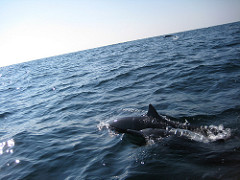
Spinner dolphins follow and spin

Spinner dolphins follow and spin

Spinner dolphins are a smaller dolphin with long slender rostrums and this pod was completely gray in color, both dorsal and ventral. Our guide told us that the males had a kind of backward dorsal fin where the curve is forward, toward the head. I had never heard of this before but it was very true, we saw dolphin with this unfamiliar dorsal fin shape. We also saw several dolphins with dorsal fins that were folded over and some that looked like the dorsal was completely cut off. Also very striking was that we saw not a rake mark in the bunch.
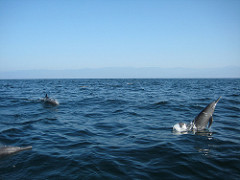
Spinner dolphins following and spinning

Spinner dolphins spinning and jumping

After an hour or so of taking a gazillion photos and video the boat Capitan persuaded us we had to head back toward shore. None of us wanted to leave. On the way back we saw Pacific green sea turtles (Chelonia mydas) mating, spotted eagle rays (Myliobatis sp.) jumping and spotted dolphin (Stenella attenuata) that were so shy they would ride the bow of the boat for only a few seconds and then vanish as quickly as they appeared.

I’m thankful to Paco and Paula for not only sharing the experience with us but also for sharing their great video. I’m extremely grateful that all of us walked away that afternoon with a huge appreciation of what we had just experienced. I’m also very thankful to my husband Mike for inspiring us to book the fishing trip. Which reminds me, what happened to the fish? I had never seen a bunch of people so happy after not catching any fish. Guess we forgot all about them once we shared our lives for a brief moment with surely one of the coolest species on the planet. .
November 16 2009

IMATA Career Building Workshop

Tagged Under : , , , , , ,

ABC Dolphin Trainer Academy had the honor to do a workshop at this year’s 37th International Marine Animal Trainers’ Association (IMATA) annual conference in Atlanta, GA. The workshop was called Career Building and we had three experienced instructors who provided tips and insights regarding career options, how to build resumes and how to do successful interviews. The response from those who participated in this workshop has been overwhelming. It was a true joy to meet many of you after the workshop and I continue to receive emails from those of you interested in pursuing a career in marine mammal training and I am humbled by your enthusiasm, passion and determination.

Together we will continue to improve the quality of the animal’s lives living under our care. You are the industries future and indeed I see a promising future for you and the animals you will care for. For those of you fortunate enough to attend the IMATA conference the theme was Teamwork and we all walked away I think with a true sense of what that means for us each and every day in our schools, jobs, and family.

Keep up the good work, and hopefully we will see you at next years IMATA conference in Boston for Career Building 2, the ABC Dolphin Trainer Academy is committed to you and we work hard every day towards our mission: to promote careers in marine mammal training and provide students with skills and knowledge to elevate their careers.

ABC Dolphin Trainer Academy at Dolphin Discovery, Isla Mujeres

ABC Dolphin Trainer Academy at Dolphin Discovery, Isla Mujeres

September 10 2009

From pinnipeds to tigers, a zoo perspective

Tagged Under : , , , , , , , , , , , , , , , , , , , , , , ,

Since I was young, I have always dreamed of becoming a marine mammal trainer and in 1988 began by volunteering at a pinniped facility in Milwaukee, WI, which provided shows and interactive programs to the zoo going public. I was fortunate to be hired and began training seals and sea lions just two years later in 1990 and soon became the Senior Trainer. Because the sea lion facility was based in a zoo, the opportunity arose to consult in other areas of the zoo that had training needs and I was able to teach keepers to train a variety of other zoo species operant conditioning techniques to allow simple shifting to complex behaviors in order to cooperate in their own medical care. I quickly became passionate with the ability to teach keepers how to provide the best possible care for their animals which includes shifting animals on/off exhibit or from one enclosure to another as well as to perform medical behaviors from body part presents to advanced behaviors such as blood draws and hand injections.

Protected Contact Training

Protected Contact Training

This was a challenge initially as the training with bonobos, gorillas, orangutans, giraffes and elephant is protected contact and is very different from training a sea lion where they are able to physically interact with you. Protected contact was new to me and it means there was a barrier between you and the animals. It is very exciting to see how the same training techniques can be applied to so many different species and how the training at times needs to be modified depending on the species and of course the institutions’ goals. After 10 years in Milwaukee working with an extremely diverse group of animals and trainers/keepers, I decided it was time to venture out on my own and I started my own training consultation company.
I started my first contract with Como Zoo in St. Paul, MN with the primary purpose of developing their seal/sea lion training and educational programs. Just as in Milwaukee, once the keepers from different departments noticed the positive changes that were made with the pinniped collection they wanted to start training their animals. Soon a zoo wide program was initiated and ultimately developed over several years to include the great apes (orangutans & gorillas), hoof stock (zebra, giraffe, kudu), big cats (cougars, snow leopards, tigers, lions) as well as sloths, porcupines, foxes, wolves, snakes, polar bears and tortoises. I have found the key for a successful program is to develop a trusting relationship with all the keepers I work with. The keepers know their animals best and since I only make site visits, it is imperative the keepers relay they correct information back to me. I then began working with Blank Park Zoo in Des Moines, IA to develop their seal/sea lion educational program as well as a big cat training program.

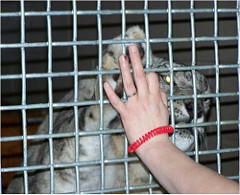
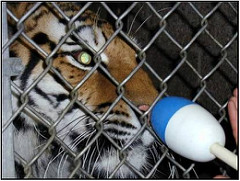
Target training snow leopard

Paw present snow leopard

After several years of training, the lions perform in educational demonstrations for the public to not only show how we can perform voluntary husbandry behaviors but also to highlight their natural behaviors to show a conservation message. The zoo noted the many benefits that the training provided and the program expanded to the whole zoo collection to include gibbons, otters, hoof stock, red pandas and a red tail hawk. I have also had the great opportunity to provide training seminars and training program evaluations for various zoos throughout the mid west.

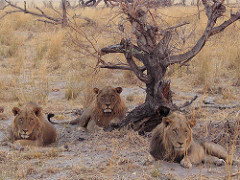
I never thought when I was young that I truly would be training all these species of animals…dreams can come true if you work hard and are open to what comes across your path in life. This part of my life I did not expect and I am so grateful to be able to get involved and that is conservation work. My partner Dr. Mike Briggs and I started our own not-for-profit organization to perform carnivore research in Africa. I received a veterinary technician’s certification and license in 2004 and we began field work in Africa where Mike had been doing this work for years. Our organization, the African Predator Conservation Research Organization (APCRO) www.apcro.org, goal is to preserve the various carnivores found on the continent of Africa (lions, hyena, wild dogs, leopards, cheetah and jackals). We are a veterinary based organization looking primarily at disease transmission in novel species, emergence of new disease and the genetic and nutritional factors that may be influencing this problem. Doing conservation work to help preserve carnivores along with working with zoos to provide the best care for the animals allows for very complete feeling of self fulfillment, gratefulness, and humbleness to have the pleasure of fulfilling your personal and spiritual goals while spending your life struggling along with others who have the same passion for the best life of both captive and wild animals.

 African Predator Conservation Research Organization (APCRO) www.apcro.org

African Predator Conservation Research Organization (APCRO) www.apcro.org

September 10 2009

Bio Beth Ament,CVT

Tagged Under : , , , , , , , , , , , , , , ,

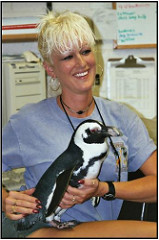
Beth Ament, CVT and Animal Behavior Consultant

Beth Ament, CVT and Animal Behavior Consultant

My training career began in 1988 at the Milwaukee County Zoo (MCZ) providing marine mammal educational programs to the public. During my 10 years with the zoo I assisted in developing public interactive programs with pinnipeds. During my period of work in MCZ, my role was expanded to consult with the rest of the zoo collection to provided behavioral consultation to many of the other zoo species to develop and implement a program of husbandry behaviors. I was anxious to work with other species and facilities as I could see how advantageous these training techniques were for the zoo keepers, veterinarians, and the animals, so I began my own behavioral consultancy. I consulted with Como Zoo in St. Paul, MN training the aquatics staff with the pinnipeds. This work grew into working with gorillas, orangutans, big cats, hoof stock and several other species, including birds and reptiles. My consultancy has expanded to include the Blank Park Zoo, Des Moines, IA with providing educational programs and husbandry training for the pinniped collection and husbandry training and keeper chats with the big cat facility. The training program has grown to a zoo-wide training program to include many other species. In addition, I continue to provide training seminars and training program evaluations to many zoos in the Midwest region.
I am also the co-founder and Executive Administrator for African Predator Conservation Research Organization (APCRO). www.apcro.org I received my Certified Veterinary Technician certificate in 2004 and I am currently a licensed veterinary technician.

August 24 2009

Manatee Husbandry Training

Tagged Under : , , , , , , , , , , , , , ,

When Shelley asked me to write a blog, I was a bit hesitant because I have never “blogged” before….so bear with me if my comments aren’t presented in the typical fashion. For those of you that don’t know me, I was the Manatee Care and Training Coordinator at Mote Marine Laboratory & Aquarium for a decade (or so…) before working with Sea Life Park for a couple of years, and then was fortunate to land in my current Vice President of Conservation position with the Association of Zoos and Aquariums (AZA). As you can probably guess, two of my life passions include manatees and conservation…with that in mind…I thought I would focus my first blog on a topic that we as trainers usually first focus on with our animals – husbandry, or medical, training.

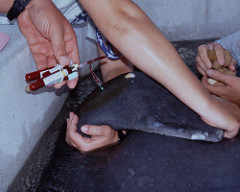
Voluntray lateral blood sampling

Voluntary lateral blood sampling

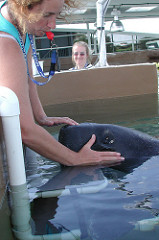
As you likely know, medical examination procedures with numerous species of non-domesticated animals in our care typically require some amount of physical or chemical restraint. An alternative to this is the implementation of an animal husbandry training program that uses standard operant conditioning with positive reinforcement techniques. The convenience of having animals voluntarily participate in routine medical procedures reduces their level of stress, increases health assessment opportunities, improves their level of care, furthers collection of baseline biological data, facilitates physiological research, and provides a dynamic form of environmental enrichment.
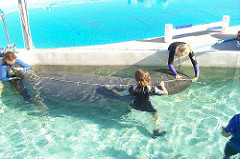
Medical procedures with untrained manatees require that the animal be dry-docked and restrained by numerous personnel. Husbandry training facilitates medical procedures typically carried out with restrained manatees, such as blood sampling, weight, dorsal ultrasound, body length, and girth measurements. Utilizing trained voluntary behaviors with manatees, allows these medical procedures to be conducted with increased frequency while reducing the number of handlers and amount of time needed per examination.
In addition, procedures difficult to obtain and rarely conducted with manatees when they are restrained, such as respirometry, ventral ultrasound, urine sampling, and core temperature measurements can become routine and incorporated into valuable physiological research investigations. Samples and measurements collected on a routine basis can be analyzed and the results can be used to augment our knowledge of the manatee’s physiology. Some of the studies conducted have provided important information about what factors affect manatee creatinine (stress) levels, how they thermoregulate, what hormonal fluctuations they cycle through, and how their respiratory characteristics contribute to red tide impacts. This information has direct conservation applications for both the in situ and ex situ manatee populations….and is made possible by basic husbandry training…how awesome is that!?

voluntary body length measurement

voluntary body length measurement

August 24 2009

Debborah Colbert’s Bio

Tagged Under : , , , , , , , , ,

voluntary eye exam

voluntary eye exam

Debi was responsible for initiating the 1st USFWS permitted Manatee Training Program in the U.S. and was the Manatee Care and Training Coordinator at Mote Marine Laboratory and Aquarium for over nine years. She has an extensive background in conservation research training, with a particular focus on manatee sensory biology, behavior, animal training and husbandry, but also has cetacean stranding and sea turtle training and care experience.

She was also the Director of Research and Education at Sea Life Park in Hawaii, has served as Secretary on the International Marine Animal Trainers Association’s (IMATA) Board of Directors, and is currently their Research and Conservation Committee Chair.

Currently, she is the Vice President for Animal Conservation with the Association for Zoos and Aquariums (AZA) and is responsible for overseeing AZA’s core animal programs, facilitating the work of AZA’s members in cooperative population and collections management, and the advancement of AZA’s conservation and science initiatives.

She earned her Ph.D. in psychology (cognitive and neuroscience) from the University of South Florida.

June 30 2009

The Best Trainer in the World

Tagged Under : , , , , , , , , , , , , , , , , ,

Who is the best trainer in the world?

You only have to look in the mirror to find the best trainer

You only have to look in the mirror to find the best trainer

When somebody asks this question, for sure a couple of names will pop into your head: maybe the people that have published a couple of books; your boss; a co-worker or even a friend of yours.
OK!
Those are all possibilities and of course make sense, but did you ever think that it could be you?
Yep!
Maybe you do not have that many years of experience behind you or the other way around, you have lots of experience but nobody knows your name. Sometimes, to be the best, it isn’t necessary to have either of these aspects because to do our work properly we need passion, therefore:
The best trainer in the world is the one that has fun doing what they love.
We need to grasp the meaning of this because if we just read it, we might think of “having a party with the animals” or “partying like an animal”, which is worse, and believe me, that’s not what it is about!
To make it clear I should start from the basics:
Humility
To succeed in any field, being humble creates an opportunity for understanding. By not just reacting to uncomfortable situations or lack of progress, it enables you to listen and be open to different options, gaining new perspectives from others. It gives you the opportunity to improve yourself, enhancing communications with your co-workers and therefore being able to maintain the highest standards for the animals under your care.
Ego is not a tool that is useful to our work, but a Smile, definitely - YES!
Being humble is a premier quality in interacting with co-workers and it is a core competency in working with animals.
Do these phrases sound familiar:
“My dolphin is too lazy today!”
“My sea lion is not paying attention at all!”
“My dolphin did not want to come out from the holding pen!”

It is at this point that we need to be humble. To admit that, actually, it is not the animals that are failing, it is we the trainers who are failing the animals because we are no longer providing them with the right communications, stimuli or even the tools to motivate them so that they can reach the proper criteria.
We might even say:
“There are no difficult animals only stubborn trainers!”
Each animal has their own likes, dislikes and has different moods as well. There is no difference between a young calf and an animal with years of experience in training. We need to understand the scenario and read the body language at that given moment, to understand what is going on.
Not having a clue as to what would happen and pushing an animal to do certain behaviours or reach a criteria can become frustrating and therefore, removes any element of fun, with the result that your animal will fail as many times as you ask for the Sd or whatever you are working on.
• Observe the scenario, including peripherals.
Read the body language, what is the animal showing you,
• Work with a variety of reinforcement schedules and use different stimuli to lead the session to success.

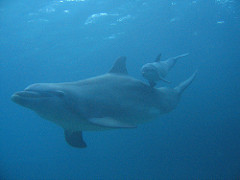
Mom and calf Dolphin Discovery Cozumel

Mom and calf Dolphin Discovery Cozumel

For instance:
I was working in Dolphin Discovery, Riviera Maya, Mexico and I had under my charge a female dolphin named Venus (12 years old) and she just had a baby, Audry (3 months old). At that time she was in a holding pen big enough to hold another female, Athena (15 years old), and her calf, Frida (3 months old).
Venus, who had many years of training at that time, was really fun and even easy; she could learn a new behaviour in a really short period of time. I must say at this point that she had fantastic trainers before me who had worked with her in a really positive way all the time, therefore TRUST was a main component of the relationship with her.
The facility was undergoing a few changes and a new holding pen was being built specifically as a maternity pen. Once the maternity pen was completed we needed to move all four animals into their new home.
A plan was made and everything went really smoothly, each mother did their work in bringing their calves through the gates with them. Edgar Urbina was in charge of this operation and during the whole process everything was perfect; fast, clean and smooth!
Once we had the dolphins in their new home we were ready to do the first session on the submerged platform. Venus was already aware of this stimulus and would not be a problem at all, that’s what I thought!
Starting with myself on the platform, asking for station, Venus was cruising twenty feet away from me and only occasionally peeking at me.
Having this scenario, I had decided to bring a target pole to motivate her to come and also did a couple of hand slaps on the surface of the water. No response from her, not even one foot closer and, of course, having my boss standing behind me, this was not exactly what I was expecting!
Throwing fish to her or swimming out of the platform was not the proper plan to follow, Venus was experienced and doing that would be taking too many steps backwards - that was my thought-
Having this on my mind, I clearly remember Edgar’s voice telling me:
- Remember, you should do all sessions positively. Look at the scenario, which is new, and use a continuous schedule of reinforcements, with good and nice approximations, and you will have success. Swim out for her!


And YES! It worked as if by magic!
I swam out, hand target right in front of her, a continuous schedule of reinforcements, swimming all the way back to the platform, and she came with me, no problem at all. As soon as we reached the platform, I gave her a jackpot and we finished the session on a positive note.
The next session in the new area with her was very smooth and easy, like she’d always done it.
Factors that may have caused this avoidance behaviour by Venus in the new area:
• New area, protecting the calf.
• Stress from the session before, gating.
Solution:
Work on trust with Venus by swimming towards her and using a continuous schedule of reinforcements, with small approximations, making the new area positive and safe for her, and therefore for her calf.
With Venus, in this particular case, Venus responded quickly due to her background training and her personality, but with another animal it might take a little longer but just as effective!
My point being that the best trainer in the world lives inside every trainer; it’s just a matter of understanding the path that you need to follow, according to the animal that you are working with. Maybe these points might give you a better understanding:
• Learn to read your animal’s body language.
• Beware of any changes in the scenario and make it work.
• Always work on positive approximations.
• Do not push, do understand the scenario instead.
• If something goes wrong, be cool and do not draw attention to it.
And most important of all: be humble at all times in order to see what you are doing wrong and next time, do it easy and make it clear for the animal, in a positive way, in order for them to succeed.
ABC of Animal Training will guide you to find the best trainer in the world inside yourself for sure.
And I would like to steal the phrase,
Happy Training!
That word means a lot if you really think about it.

Cheers Mates.

Happy Training!

Happy Training!

June 11 2009

Are we tamers or… Trainers?

Tagged Under : , , , , , , , , , , , , , , , , , , , , , , , , , , , , , ,

We have shared the earth with animals since Homo sapiens walked the planet and in the beginning, like it or not, we viewed them solely as a source of food. As time passed, we saw them as tools to help make our tasks easier and then finally, we have domesticated them for companionship.
When we talk about marine mammals, and specifically Dolphins, we find a multitude of stories about these creatures, for instance;

As noted by Bearzi and Stanford (2008, pg. 18). “Intelligence, consciousness and compassion were among the words used by the ancient Greeks to describe their ‘companions of the sea’. The philosopher Plutarch regarded them as the only creatures that seek friendship for purely altruistic reasons. Greek myths portray that culture’s fascination with dolphins: the sun god Apollo assumed the form of a dolphin when he founded his oracle at Delphi on the slopes of Mount Parnassus, and Orion was saved from drowning by a sociable dolphin and carried into the sky, riding on his back.

Dionysus the Greek god of wine and mirth, who once booked passage on a ship from the island of Ikaria bound for Naxos. The ship’s crew was actually a band of pirates posing as merchant sailors, whose secret plan was to capture their passengers and sell them into slavery. When Dionysus discovererd their conspiracy, he used his divine powers to punish them by causing the ship’s mast to sprout branches, the men’s oars to become snakes and a strange flute to play. To escape this divine madness, the pirates cast themselves into the water where the ocean god Poseidon change them into dolphins and commanded them to serve humankind forever.

A century later, the Roman philosopher Pliny the Elder told the story of a peasant boy living on the shores of the Mediterranean Sea who befriended a solitary dolphin named Simo. Everyday Simo used to take the boy on his back across a stretch of water between the child’s home and his school. Tragically, the boy fell sick and died. Upon the boy’s death and for many days thereafter, Simo kept returning to the place of their meeting until he too died of a broken heart. Simo’s story is one of the countless legends of friendship between children and dolphins that were popular during the Roman Empire. As it was with the Greeks, the Romans were fascinated with these creatures.
Leaving mythology aside and getting back to business, I should make mention of Germany’s Carl Hagenbeck (1844–1913), who is considered the father of the modern zoo, and who in 1875, trained animals for display in circuses throughout Europe and the United States. At that time, training was done in whatever way they felt like doing it. Carl Hagenbeck always dreamed of a permanent exhibit where animals could live without bars and in surroundings much like their natural environments. His vision went on to become the basis of today’s zoological exhibits and was even considered the beginnings of the cinema experience!
Starting in 1943, B.F. Skinner pioneered a theory of behaviour modification utilising a technique called Shaping (hand-shaping), which is generally known as Operant Conditioning and is stated as: - Behaviour is a function of its consequences; consequences are what follow a behaviour.

And this has revolutionized animal training!

At Dolphin Discovery, the ABC Animal Training program is based on this technique and using it, we are able to achieve very impressive co-operative behaviours from our animals.
Some examples being;
training manatees for voluntary blood samples,

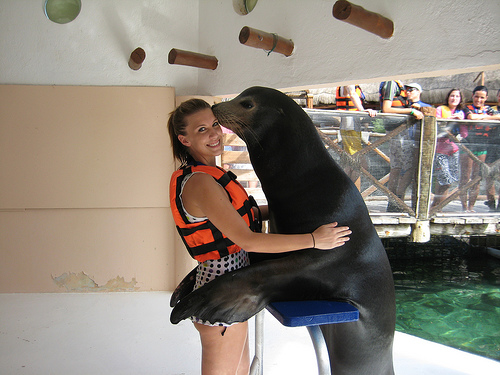
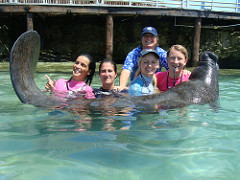
Jackie gets a hug at ABC Dolphin Trainer Academy

Jackie gets a hug at ABC Dolphin Trainer Academy

• facilitating Tamarin monkeys’ ability for recall,
• interactive programs and diving with sea lions
• the best interactive programs with dolphins.


People dream of petting dolphins and in enabling them to do this, we ensure that all of our interactions with the animals are based entirely on positive reinforcements.
Therefore:
Each interaction with the animals should be interesting and mentally stimulating, even fun.
• Desirable behaviours must be reinforced with primary and secondary reinforcements, not drawing attention to undesirable behaviours.
Relationships are built based on mutual trust and respect, not only must the trainer trust they will not be harmed by the animal, but the animal must also trust that the trainer will not harm them.

A few years ago, I was in charge of the Anguilla, B.W.I. facility; a beautiful and fantastic island in the western Caribbean.
The dolphin population consisted of four boys and three girls. (4.3 dolphins)
One of them was an awesome dolphin and the sweetest girl ever named Ayla. She was eight months pregnant and I was doing some cleaning in the lagoon. After I finished, I forgot my snorkel at the edge of the pool, and with waves washing over it, it sank all the way down to the bottom.
Once the snorkel was there, Ayla found it and took it underneath her right pectoral flipper, becoming the best treasure ever for her.
She would not give it away even for two pounds of herring!
We worked out a plan with all the little details involving doing successive approximations until she gave it away by herself. With this whole experience, we found the best secondary reinforcement to use with Ayla.
The plan was really simple:
#1 - Hand target with the snout/ then primary.
#2 - Hand target with the snout and presenting left hand by right pectoral fin/then primary.
#3 - Approximation # 2 plus having the hand closer to her flipper/ then primary
#4 - Approximation # 3 plus touching her flipper/then primary.
#5 - Approximation # 4 plus touching the snorkel/then primary.
#6 - Approximation # 5 plus holding the snorkel for a sec and giving it back to her/jackpot
#7 - Approximation # 6 plus holding the snorkel and moving two steps either way/jackpot and snorkel back to her
#8 - Approximation # 7 plus coming out of the water with the snorkel/jackpot and snorkel.

The schedules of reinforcement that we used was continuous with each step and the reinforcements were primary, starting the next session one step behind the last one.
As Karen Pryor (1994) states “Positive reinforcement training constitutes an exchange of deeds for goods in which a pleasant communion arises a salutary sort of equality between animal and trainer, one cannot work without the other and both must do their part. That is reinforcing in itself, for both parties.”
At this point, I must state that “tamers” are history and we at Dolphin Discovery, we are real trainers.

References
Bearzi, M. and Stanford, C.B. (2008) Beautiful Minds: The Parallel Lives of Great Apes and Dolphins, Cambridge, Harvard University Press.
Pryor, K. (1994) On Behaviour; Essays and Research, Waltham, Mass., Sunshine Books.

May 27 2009

Raul Novelo’s Bio

Tagged Under : , , , , , , , , , , ,

Raul Novelo will never forget the first time that he saw a dolphin show, it was 1977 and he was eight years old when he visited the Miami Seaquarium. According to his mother, he stayed by the dolphin pool forever and might still be there if she hadn’t dragged him away!
In 1991 Raul graduated with a degree in Business Administration. In 1995 Raul was first hired at Via Delphi in X’caret Park and then went on to do an internship at Dolphin Quest, Bermuda.
Raul first found his career after he met Shelley and Mike Wood of Dolphin Discovery and ABC Animal Training during the regional IMATA conference in Mexico.
In 2002 Raul began his career with Dolphin Discovery Mexico and has extensive experience in British Virgin Islands working as Senior Trainer at both Dolphin Discovery location in Antigua and Anguilla and as Supervisor at both Dolphin Discovery locations in Tortola and Cayman.

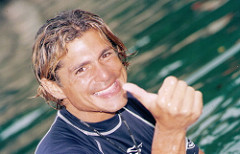
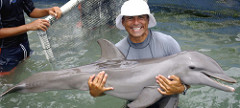
Raul with dolphn calf at Dolphin Discovery Tortola

Raul with dolphn calf at Dolphin Discovery Tortola

May 26 2009

Training in the Caribbean

Tagged Under : , , , , , , , , , , , , ,

Yah man!

Arriving on the British Virgin Islands for the very first time was one of the best experiences that I have ever had. Having four dolphins in my charge for basic training and making them feel comfortable in their new environment was a learning opportunity every single day. Even though I am experienced with dolphins, this represented a big challenge for me.

Raul training a golden hand tamarin monkey Dolphin Discovery

Raul training a golden hand tamarin monkey Dolphin Discovery

Training was just a small part of the experience that helped me to sharpen my skills and to become the person and trainer that I am today.
What really taught me how to be a trainer was, on a daily basis, living in a new place, in a different culture, with a huge diversity of races, plus having no guacamole! Even though I have lived in many places in the world, the Caribbean at that time, was a different experience for me; it was way too laid back. For instance, the exasperating attitude of; “Don’t worry, yah man, tomorrow will be ready”, when you really needed it yesterday!
My point being, if you don’t open yourself up to new opportunities and learn from them, you will never be able to find a way to get the best out of the circumstances that you encounter. No matter what, without exception, you can always find something worthwhile to learn.
You must believe in yourself and your dreams. It’s really easy to say but once you have it in the forefront of your thoughts, things do turn out differently, and believe me - it’s true!
What is your goal in life and what are your dreams? For sure you must first have an idea, then follow it, fight for it and do not let any obstacle steer you away from it, even to the point of quitting. Focus on your dream and make it happen.
We are always going to crash into something that we don’t like, that makes us feel uncomfortable or perhaps even something worse. Yeah, that’s for sure!
If you reach a stage where you feel you are breaking down, thinking “that is enough” or, that you do not deserve it, this is going to take you nowhere. You will not be thinking clearly and all the possibilities of success will fade away, therefore:
“I got stuck and I cannot do it”, will become part of your life.
Putting this attitude into a training scenario, these would be your thoughts while you are doing your job with the animals that you love the most. This wouldn’t be fair to them because there is always a little spark of opportunity in front of you and with an understanding of the scenario, you will get it.
This is what ABC is about; never to have the attitude of being closed to any option or having one of failure. That it teaches the best way to understand animals’ needs and how to see them, improving the animals’ life within any single session and even how to apply it to your fellow mates, remember that little spark is always in front of you.
Putting it this way - use the right criteria, according to the right scenario, through positive reinforcements. And then you will reach the next step!
In my case – my “Yah man” experience really helped me to grow as a person and being a part of ABC has made everything easier and taught me how to communicate in a better way with both animals and humans.

Raul training a tail splash Dolphin Discovery Cayman

Raul training a tail splash Dolphin Discovery Cayman

To grasp it was not easy but Dolphin Discovery is a great family that offers extensive support and listens to your concerns.
ABC is a part of Dolphin Discovery. I am proud to say that I am a member of Dolphin Discovery and I love every single moment of my experience, there are so many stories to tell and all of them have a smile in them…..
Jeez, I just got goosebumps!
Cheers heaps Mates! Raul