June 11 2009
Are we tamers or… Trainers?
Tagged Under : ABC Animal Training, Anguilla, animal, animal training, Approximation, B.F. Skinner, behavior, Carl Hagenbeck, companions of the sea, consequences, Dionysus the Greek god, dolphins, interactive programs, Karen Pryor, manatees, Marine Mammals, mythology, ocean god Poseidon, Orion, Plutarch, Positive reinforcement training, primary reinforcement, Roman philosopher Pliny the Elder, schedule of reinforcement, sea lions, sun god Apollo, Tamarin monkeys, trainer, training, western Caribbean, zoological exhibits
We have shared the earth with animals since Homo sapiens walked the planet and in the beginning, like it or not, we viewed them solely as a source of food. As time passed, we saw them as tools to help make our tasks easier and then finally, we have domesticated them for companionship.
When we talk about marine mammals, and specifically Dolphins, we find a multitude of stories about these creatures, for instance;
As noted by Bearzi and Stanford (2008, pg. 18). “Intelligence, consciousness and compassion were among the words used by the ancient Greeks to describe their ‘companions of the sea’. The philosopher Plutarch regarded them as the only creatures that seek friendship for purely altruistic reasons. Greek myths portray that culture’s fascination with dolphins: the sun god Apollo assumed the form of a dolphin when he founded his oracle at Delphi on the slopes of Mount Parnassus, and Orion was saved from drowning by a sociable dolphin and carried into the sky, riding on his back.
Dionysus the Greek god of wine and mirth, who once booked passage on a ship from the island of Ikaria bound for Naxos. The ship’s crew was actually a band of pirates posing as merchant sailors, whose secret plan was to capture their passengers and sell them into slavery. When Dionysus discovererd their conspiracy, he used his divine powers to punish them by causing the ship’s mast to sprout branches, the men’s oars to become snakes and a strange flute to play. To escape this divine madness, the pirates cast themselves into the water where the ocean god Poseidon change them into dolphins and commanded them to serve humankind forever.
A century later, the Roman philosopher Pliny the Elder told the story of a peasant boy living on the shores of the Mediterranean Sea who befriended a solitary dolphin named Simo. Everyday Simo used to take the boy on his back across a stretch of water between the child’s home and his school. Tragically, the boy fell sick and died. Upon the boy’s death and for many days thereafter, Simo kept returning to the place of their meeting until he too died of a broken heart. Simo’s story is one of the countless legends of friendship between children and dolphins that were popular during the Roman Empire. As it was with the Greeks, the Romans were fascinated with these creatures.
Leaving mythology aside and getting back to business, I should make mention of Germany’s Carl Hagenbeck (1844–1913), who is considered the father of the modern zoo, and who in 1875, trained animals for display in circuses throughout Europe and the United States. At that time, training was done in whatever way they felt like doing it. Carl Hagenbeck always dreamed of a permanent exhibit where animals could live without bars and in surroundings much like their natural environments. His vision went on to become the basis of today’s zoological exhibits and was even considered the beginnings of the cinema experience!
Starting in 1943, B.F. Skinner pioneered a theory of behaviour modification utilising a technique called Shaping (hand-shaping), which is generally known as Operant Conditioning and is stated as: - Behaviour is a function of its consequences; consequences are what follow a behaviour.
And this has revolutionized animal training!
At Dolphin Discovery, the ABC Animal Training program is based on this technique and using it, we are able to achieve very impressive co-operative behaviours from our animals.
Some examples being;
• training manatees for voluntary blood samples,
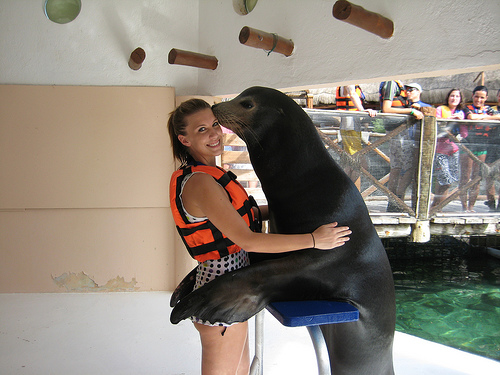
Jackie gets a hug at ABC Dolphin Trainer Academy
• facilitating Tamarin monkeys’ ability for recall,
• interactive programs and diving with sea lions
• the best interactive programs with dolphins.
People dream of petting dolphins and in enabling them to do this, we ensure that all of our interactions with the animals are based entirely on positive reinforcements.
Therefore:
• Each interaction with the animals should be interesting and mentally stimulating, even fun.
• Desirable behaviours must be reinforced with primary and secondary reinforcements, not drawing attention to undesirable behaviours.
• Relationships are built based on mutual trust and respect, not only must the trainer trust they will not be harmed by the animal, but the animal must also trust that the trainer will not harm them.
A few years ago, I was in charge of the Anguilla, B.W.I. facility; a beautiful and fantastic island in the western Caribbean.
The dolphin population consisted of four boys and three girls. (4.3 dolphins)
One of them was an awesome dolphin and the sweetest girl ever named Ayla. She was eight months pregnant and I was doing some cleaning in the lagoon. After I finished, I forgot my snorkel at the edge of the pool, and with waves washing over it, it sank all the way down to the bottom.
Once the snorkel was there, Ayla found it and took it underneath her right pectoral flipper, becoming the best treasure ever for her.
She would not give it away even for two pounds of herring!
We worked out a plan with all the little details involving doing successive approximations until she gave it away by herself. With this whole experience, we found the best secondary reinforcement to use with Ayla.
The plan was really simple:
#1 - Hand target with the snout/ then primary.
#2 - Hand target with the snout and presenting left hand by right pectoral fin/then primary.
#3 - Approximation # 2 plus having the hand closer to her flipper/ then primary
#4 - Approximation # 3 plus touching her flipper/then primary.
#5 - Approximation # 4 plus touching the snorkel/then primary.
#6 - Approximation # 5 plus holding the snorkel for a sec and giving it back to her/jackpot
#7 - Approximation # 6 plus holding the snorkel and moving two steps either way/jackpot and snorkel back to her
#8 - Approximation # 7 plus coming out of the water with the snorkel/jackpot and snorkel.
The schedules of reinforcement that we used was continuous with each step and the reinforcements were primary, starting the next session one step behind the last one.
As Karen Pryor (1994) states “Positive reinforcement training constitutes an exchange of deeds for goods in which a pleasant communion arises a salutary sort of equality between animal and trainer, one cannot work without the other and both must do their part. That is reinforcing in itself, for both parties.”
At this point, I must state that “tamers” are history and we at Dolphin Discovery, we are real trainers.
References
Bearzi, M. and Stanford, C.B. (2008) Beautiful Minds: The Parallel Lives of Great Apes and Dolphins, Cambridge, Harvard University Press.
Pryor, K. (1994) On Behaviour; Essays and Research, Waltham, Mass., Sunshine Books.