August 24 2009
Manatee Husbandry Training
Tagged Under : "environmental enrichment", "husbandry training", "Mote Marine Labora"tory & Aquarium", "operant conditiioning", "positive reinforcement", "Sea Life Park ", animal, animal training, animal training career, AZA, conservation, manatee, shelley, trainer, training
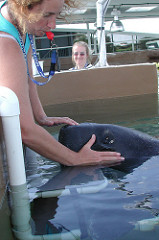
When Shelley asked me to write a blog, I was a bit hesitant because I have never “blogged” before….so bear with me if my comments aren’t presented in the typical fashion. For those of you that don’t know me, I was the Manatee Care and Training Coordinator at Mote Marine Laboratory & Aquarium for a decade (or so…) before working with Sea Life Park for a couple of years, and then was fortunate to land in my current Vice President of Conservation position with the Association of Zoos and Aquariums (AZA). As you can probably guess, two of my life passions include manatees and conservation…with that in mind…I thought I would focus my first blog on a topic that we as trainers usually first focus on with our animals – husbandry, or medical, training.
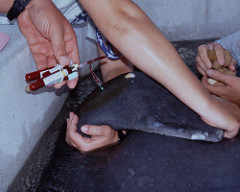
Voluntary lateral blood sampling
As you likely know, medical examination procedures with numerous species of non-domesticated animals in our care typically require some amount of physical or chemical restraint. An alternative to this is the implementation of an animal husbandry training program that uses standard operant conditioning with positive reinforcement techniques. The convenience of having animals voluntarily participate in routine medical procedures reduces their level of stress, increases health assessment opportunities, improves their level of care, furthers collection of baseline biological data, facilitates physiological research, and provides a dynamic form of environmental enrichment.
Medical procedures with untrained manatees require that the animal be dry-docked and restrained by numerous personnel. Husbandry training facilitates medical procedures typically carried out with restrained manatees, such as blood sampling, weight, dorsal ultrasound, body length, and girth measurements. Utilizing trained voluntary behaviors with manatees, allows these medical procedures to be conducted with increased frequency while reducing the number of handlers and amount of time needed per examination.
In addition, procedures difficult to obtain and rarely conducted with manatees when they are restrained, such as respirometry, ventral ultrasound, urine sampling, and core temperature measurements can become routine and incorporated into valuable physiological research investigations. Samples and measurements collected on a routine basis can be analyzed and the results can be used to augment our knowledge of the manatee’s physiology. Some of the studies conducted have provided important information about what factors affect manatee creatinine (stress) levels, how they thermoregulate, what hormonal fluctuations they cycle through, and how their respiratory characteristics contribute to red tide impacts. This information has direct conservation applications for both the in situ and ex situ manatee populations….and is made possible by basic husbandry training…how awesome is that!?
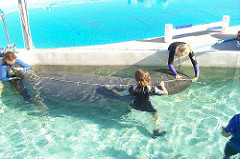
voluntary body length measurement