June 30 2009
The Best Trainer in the World
Tagged Under : "avoidance behaviour", "body language", "continuous schedule of reinforcements", "Positive sessions", "reinforcement schedules", "Riviera Maya", ABC Animal Training, animal, animal training, approximations, communication, dolphin, dolphin discovery, humility, motivation, stimuli, trainer, trust
Who is the best trainer in the world?

You only have to look in the mirror to find the best trainer
When somebody asks this question, for sure a couple of names will pop into your head: maybe the people that have published a couple of books; your boss; a co-worker or even a friend of yours.
OK!
Those are all possibilities and of course make sense, but did you ever think that it could be you?
Yep!
Maybe you do not have that many years of experience behind you or the other way around, you have lots of experience but nobody knows your name. Sometimes, to be the best, it isn’t necessary to have either of these aspects because to do our work properly we need passion, therefore:
The best trainer in the world is the one that has fun doing what they love.
We need to grasp the meaning of this because if we just read it, we might think of “having a party with the animals” or “partying like an animal”, which is worse, and believe me, that’s not what it is about!
To make it clear I should start from the basics:
Humility
To succeed in any field, being humble creates an opportunity for understanding. By not just reacting to uncomfortable situations or lack of progress, it enables you to listen and be open to different options, gaining new perspectives from others. It gives you the opportunity to improve yourself, enhancing communications with your co-workers and therefore being able to maintain the highest standards for the animals under your care.
Ego is not a tool that is useful to our work, but a Smile, definitely - YES!
Being humble is a premier quality in interacting with co-workers and it is a core competency in working with animals.
Do these phrases sound familiar:
“My dolphin is too lazy today!”
“My sea lion is not paying attention at all!”
“My dolphin did not want to come out from the holding pen!”
It is at this point that we need to be humble. To admit that, actually, it is not the animals that are failing, it is we the trainers who are failing the animals because we are no longer providing them with the right communications, stimuli or even the tools to motivate them so that they can reach the proper criteria.
We might even say:
“There are no difficult animals only stubborn trainers!”
Each animal has their own likes, dislikes and has different moods as well. There is no difference between a young calf and an animal with years of experience in training. We need to understand the scenario and read the body language at that given moment, to understand what is going on.
Not having a clue as to what would happen and pushing an animal to do certain behaviours or reach a criteria can become frustrating and therefore, removes any element of fun, with the result that your animal will fail as many times as you ask for the Sd or whatever you are working on.
• Observe the scenario, including peripherals.
• Read the body language, what is the animal showing you,
• Work with a variety of reinforcement schedules and use different stimuli to lead the session to success.
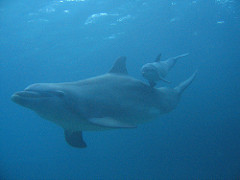
Mom and calf Dolphin Discovery Cozumel
For instance:
I was working in Dolphin Discovery, Riviera Maya, Mexico and I had under my charge a female dolphin named Venus (12 years old) and she just had a baby, Audry (3 months old). At that time she was in a holding pen big enough to hold another female, Athena (15 years old), and her calf, Frida (3 months old).
Venus, who had many years of training at that time, was really fun and even easy; she could learn a new behaviour in a really short period of time. I must say at this point that she had fantastic trainers before me who had worked with her in a really positive way all the time, therefore TRUST was a main component of the relationship with her.
The facility was undergoing a few changes and a new holding pen was being built specifically as a maternity pen. Once the maternity pen was completed we needed to move all four animals into their new home.
A plan was made and everything went really smoothly, each mother did their work in bringing their calves through the gates with them. Edgar Urbina was in charge of this operation and during the whole process everything was perfect; fast, clean and smooth!
Once we had the dolphins in their new home we were ready to do the first session on the submerged platform. Venus was already aware of this stimulus and would not be a problem at all, that’s what I thought!
Starting with myself on the platform, asking for station, Venus was cruising twenty feet away from me and only occasionally peeking at me.
Having this scenario, I had decided to bring a target pole to motivate her to come and also did a couple of hand slaps on the surface of the water. No response from her, not even one foot closer and, of course, having my boss standing behind me, this was not exactly what I was expecting!
Throwing fish to her or swimming out of the platform was not the proper plan to follow, Venus was experienced and doing that would be taking too many steps backwards - that was my thought-
Having this on my mind, I clearly remember Edgar’s voice telling me:
- Remember, you should do all sessions positively. Look at the scenario, which is new, and use a continuous schedule of reinforcements, with good and nice approximations, and you will have success. Swim out for her!
And YES! It worked as if by magic!
I swam out, hand target right in front of her, a continuous schedule of reinforcements, swimming all the way back to the platform, and she came with me, no problem at all. As soon as we reached the platform, I gave her a jackpot and we finished the session on a positive note.
The next session in the new area with her was very smooth and easy, like she’d always done it.
Factors that may have caused this avoidance behaviour by Venus in the new area:
• New area, protecting the calf.
• Stress from the session before, gating.
Solution:
Work on trust with Venus by swimming towards her and using a continuous schedule of reinforcements, with small approximations, making the new area positive and safe for her, and therefore for her calf.
With Venus, in this particular case, Venus responded quickly due to her background training and her personality, but with another animal it might take a little longer but just as effective!
My point being that the best trainer in the world lives inside every trainer; it’s just a matter of understanding the path that you need to follow, according to the animal that you are working with. Maybe these points might give you a better understanding:
• Learn to read your animal’s body language.
• Beware of any changes in the scenario and make it work.
• Always work on positive approximations.
• Do not push, do understand the scenario instead.
• If something goes wrong, be cool and do not draw attention to it.
And most important of all: be humble at all times in order to see what you are doing wrong and next time, do it easy and make it clear for the animal, in a positive way, in order for them to succeed.
ABC of Animal Training will guide you to find the best trainer in the world inside yourself for sure.
And I would like to steal the phrase,
Happy Training!
That word means a lot if you really think about it.
Cheers Mates.

Happy Training!